Sunday, February 14, 2016

Permanent Magnet Synchronous Generator


Permanent magnet synchronous generator is a generator where the excitation field is provided by a permanent magnet instead of a coil. The term synchronous refers here to the fact that the rotor and magnetic field rotate with the same speed, because the magnetic field is generated through a shaft mounted permanent magnet mechanism and current is induced into the stationary armature. 

Synchronous generators are the majority source of commercial electrical energy. They are commonly used to convert the mechanical power output of steam turbines, gas turbines, reciprocating engines and hydro turbines into electrical power for the grid. Wind turbines of any significant scale use asynchronous generators exclusively.

In the majority of designs the rotating assembly in the center of the generator—the "rotor"—contains the magnet, and the "stator" is the stationary armature that is electrically connected to a load. As shown in the diagram above, the perpendicular component of the stator field affects the torque while the parallel component affects the voltage. The load supplied by the generator determines the voltage. If the load is inductive, then the angle between the rotar and stator 
fields will be greater than $90^o$ which corresponds to an increased generator voltage. This is known as an overexcited generator. The opposite is true for a generator supplying a capacitive load which is known as an underexcited generator. A set of three conductors make up the armature winding in standard utility equipment, constituting three phases of a power circuit—that correspond to the three wires we are accustomed to see on transmission lines. The phases are wound such that they are 120 degrees apart spatially on the stator, providing for a uniform force or torque on the generator rotor. The uniformity of the torque arises because the magnetic fields resulting from the induced currents in the three conductors of the armature winding combine spatially in such a way as to resemble the magnetic field of a single, rotating magnet. This stator magnetic field or "stator field" appears as a steady rotating field and spins at the same frequency as the rotor when the rotor contains a single dipole magnetic field. The two fields move in "synchronicity" and maintain a fixed 
position relative to each other as they spin.

Thursday, February 11, 2016

3-Phase Generator


All 3-phase generators (or motors) use a rotating magnetic field.In the picture to the left we have installed three electromagnets around a circle. Each of the three magnets is connected to its own phase in the three phase electrical grid.As you can see, each of the three electromagnetsalternate between producing a South pole and a North pole towards the centre. The letters are shown in black when the magnetism is strong, and in light grey when the magnetism is weak. The fluctuation in magnetism corresponds exactly to the fluctuation in voltage of each phase. When one phase is at its peak, the other two have the current running in the opposite direction, at half the voltage. Since the timing of current in the threemagnets is one third of a cycle apart, the magnetic field will make one complete revolution per cycle.

Synchronous Motor Operation

The compass needle (with the North pole painted red) will follow the magnetic field exactly, and make one revolution per cycle. With a 50 Hz grid, the needle will make 50 revolutions per second, i.e. 50 times 60 = 3000 rpm (revolutions per minute).
In the picture above, we have in fact managed to build what is called a 2-pole permanent magnet synchronous motor. The reason why it is called a synchronous motor, is that the magnet in the centre will rotate at a constant speed which is synchronous with (running exactly like the cycle in) the rotation of the magnetic field.
The reason why it is called a 2-pole motor is that it has one North and one South pole. It may look like three poles to you, but in fact the compass needle feels the pull from the sum of the magnetic fields around its own magnetic field. So, if the magnet at the top is a strong South pole, the two magnets at the bottom will add up to a strong North pole.
The reason why it is called a permanent magnet motor is that the compass needle in the centre is a permanent magnet, not an electromagnet. (You could make a real motor by replacing the compass needle by a powerful permanent magnet, or an electromagnet which maintains its magnetism through a coil (wound around an iron core) which is fed with direct current).
The setup with the three electromagnets is called thestator in the motor, because this part of the motor remains static (in the same place). The compass needle in the centre is called the rotor, obviously because it rotates.

Synchronous Generator Operation
If you start forcing the magnet around (instead of letting the current from the grid move it), you will discover that it works like a generator, sending alternating current back into the grid. (You should have a more powerful magnet to produce much electricity). The more force (torque) you apply, the more electricity you generate, but the generator will still run at the same speed dictated by the frequency of the electrical grid.
You may disconnect the generator completely from the grid, and start your own private 3-phase electricity grid, hooking your lamps up to the three coils around the electromagnets. (Remember the principle of magnetic / electrical induction from the reference manual section of this web site). If you disconnect the generator from the main grid, however, you will have to crank it at a constant rotational speed in order to produce alternating current with a constant frequency. Consequently, with this type of generator you will normally want to use anindirect grid connection of the generator.
In practice, permanent magnet synchronous generators are not used very much. There are several reasons for this. One reason is that permanent magnets tend to become demagnetised by working in the powerful magnetic fields inside a generator. Another reason is that powerful magnets (made of rare earth metals, e.g. Neodynium) are quite expensive, even if prices have dropped lately.

Wind Turbines With Synchronous Generators
Wind turbines which use synchronous generators normally use electromagnets in the rotor which are fed by direct current from the electrical grid. Since the grid supplies alternating current, they first have to convert alternating current to direct current before sending it into the coil windings around the electromagnets in the rotor.
The rotor electromagnets are connected to the current by using brushes and slip rings on the axle (shaft) of the generator.

Synchronous Motors

Single phase synchronous motors are available in small sizes for applications requiring precise timing such as time keeping, (clocks) and tape players. Though battery powered quartz regulated clocks are widely available, the AC line operated variety has better long term accuracy—over a period of months. This is due to power plant operators purposely maintaining the long term accuracy of the frequency of the AC distribution system. If it falls behind by a few cycles, they will make up the lost cycles of AC so that clocks lose no time.

Above 10 Horsepower (10 kW) the higher efficiency and leading powerfactor make large synchronous motors useful in industry. Large synchronous motors are a few percent more efficient than the more common induction motors. Though, the synchronous motor is more complex.
Since motors and generators are similar in construction, it should be possible to use a generator as a motor, conversely, use a motor as a generator. A synchronous motor is similar to an alternator with a rotating field. The figure below shows small alternators with a permanent magnet rotating field. This figure below could either be two paralleled and synchronized alternators driven by a mechanical energy sources, or an alternator driving a synchronous motor. Or, it could be two motors, if an external power source were connected. The point is that in either case the rotors must run at the same nominal frequency, and be in phase with each other. That is, they must be synchronized. The procedure for synchronizing two alternators is to (1) open the switch, (2) drive both alternators at the same rotational rate, (3) advance or retard the phase of one unit until both AC outputs are in phase, (4) close the switch before they drift out of phase. Once synchronized, the alternators will be locked to each other, requiring considerable torque to break one unit loose (out of synchronization) from the other.


Synchronous motor running in step with alternator.
If more torque in the direction of rotation is applied to the rotor of one of the above rotating alternators, the angle of the rotor will advance (opposite of (3)) with respect to the magnetic field in the stator coils while still synchronized and the rotor will deliver energy to the AC line like an alternator. The rotor will also be advanced with respect to the rotor in the other alternator. If a load such as a brake is applied to one of the above units, the angle of the rotor will lag the stator field as at (3), extracting energy from the AC line, like a motor. If excessive torque or drag is applied, the rotor will exceed the maximum torque angle advancing or lagging so much that synchronization is lost. Torque is developed only when synchronization of the motor is maintained.
In the case of a small synchronous motor in place of the alternator Figure above right, it is not necessary to go through the elaborate synchronization procedure for alternators. However, the synchronous motor is not self starting and must still be brought up to the approximate alternator electrical speed before it will lock (synchronize) to the generator rotational rate. Once up to speed, the synchronous motor will maintain synchronism with the AC power source and develop torque.


Sinewave drives synchronous motor.
Assuming that the motor is up to synchronous speed, as the sine wave changes to positive in Figure above(1), the lower north coil pushes the north rotor pole, while the upper south coil attracts that rotor north pole. In a similar manner the rotor south pole is repelled by the upper south coil and attracted to the lower north coil. By the time that the sine wave reaches a peak at (2), the torque holding the north pole of the rotor up is at a maximum. This torque decreases as the sine wave decreases to 0 VDC at (3) with the torque at a minimum.
As the sine wave changes to negative between (3&4), the lower south coil pushes the south rotor pole, while attracting rotor north rotor pole. In a similar manner the rotor north pole is repelled by the upper north coil and attracted to the lower south coil. At (4) the sinewave reaches a negative peak with holding torque again at a maximum. As the sine wave changes from negative to 0 VDC to positive, The process repeats for a new cycle of sine wave.
Note, the above figure illustrates the rotor position for a no-load condition (α=0o). In actual practice, loading the rotor will cause the rotor to lag the positions shown by angle α. This angle increases with loading until the maximum motor torque is reached at α=90o electrical. Synchronization and torque are lost beyond this angle.
The current in the coils of a single phase synchronous motor pulsates while alternating polarity. If the permanent magnet rotor speed is close to the frequency of this alternation, it synchronizes to this alternation. Since the coil field pulsates and does not rotate, it is necessary to bring the permanent magnet rotor up to speed with an auxiliary motor. This is a small induction motor similar to those in the next section.


Addition of field poles decreases speed.
A 2-pole (pair of N-S poles) alternator will generate a 60 Hz sine wave when rotated at 3600 rpm (revolutions per minute). The 3600 rpm corresponds to 60 revolutions per second. A similar 2-pole permanent magnet synchronous motor will also rotate at 3600 rpm. A lower speed motor may be constructed by adding more pole pairs. A 4-pole motor would rotate at 1800 rpm, a 12-pole motor at 600 rpm. The style of construction shown (Figure above)) is for illustration. Higher efficiency higher torque multi-pole stator synchronous motors actually have multiple poles in the rotor.


One-winding 12-pole synchronous motor.
Rather than wind 12-coils for a 12-pole motor, wind a single coil with twelve interdigitated steel poles pieces as shown in Figure above. Though the polarity of the coil alternates due to the appplied AC, assume that the top is temporarily north, the bottom south. Pole pieces route the south flux from the bottom and outside of the coil to the top. These 6-souths are interleaved with 6-north tabs bent up from the top of the steel pole piece of the coil. Thus, a permanent magnet rotor bar will encounter 6-pole pairs corresponding to 6-cycles of AC in one physical rotation of the bar magnet. The rotation speed will be 1/6 of the electrical speed of the AC. Rotor speed will be 1/6 of that experienced with a 2-pole synchronous motor. Example: 60 Hz would rotate a 2-pole motor at 3600 rpm, or 600 rpm for a 12-pole motor.


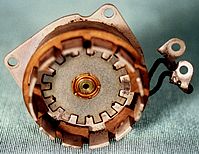
The stator (Figure above) shows a 12-pole Westclox synchronous clock motor. Construction is similar to the previous figure with a single coil. The one coil style of construction is economical for low torque motors. This 600 rpm motor drives reduction gears moving clock hands.
If the Westclox motor were to run at 600 rpm from a 50 Hz power source, how many poles would be required? A 10-pole motor would have 5-pairs of N-S poles. It would rotate at 50/5 = 10 rotations per second or 600 rpm (10 s-1 x 60 s/minute.)


The rotor (Figure above) consists of a permanent magnet bar and a steel induction motor cup. The synchronous motor bar rotating within the pole tabs keeps accurate time. The induction motor cup outside of the bar magnet fits outside and over the tabs for self starting. At one time non-self-starting motors without the induction motor cup were manufactured.
A 3-phase synchronous motor as shown in Figure below generates an electrically rotating field in the stator. Such motors are not self starting if started from a fixed frequency power source such as 50 or 60 Hz as found in an industrial setting. Furthermore, the rotor is not a permanent magnet as shown below for the multi-horsepower (multi-kilowatt) motors used in industry, but an electromagnet. Large industrial synchronous motors are more efficient than induction motors. They are used when constant speed is required. Having a leading power factor, they can correct the AC line for a lagging power factor.
The three phases of stator excitation add vectorially to produce a single resultant magnetic field which rotates f/2n times per second, where f is the power line frequency, 50 or 60 Hz for industrial power line operated motors. The number of poles is n. For rotor speed in rpm, multiply by 60.
 S = f120/n where: S = rotor speed in rpm f = AC line frequency n = number of poles per phase 
The 3-phase 4-pole (per phase) synchronous motor (Figure below) will rotate at 1800 rpm with 60 Hz power or 1500 rpm with 50 Hz power. If the coils are energized one at a time in the sequence φ-1, φ-2, φ-3, the rotor should point to the corresponding poles in turn. Since the sine waves actually overlap, the resultant field will rotate, not in steps, but smoothly. For example, when the φ-1 and φ-2 sinewaves coincide, the field will be at a peak pointing between these poles. The bar magnet rotor shown is only appropriate for small motors. The rotor with multiple magnet poles (below right) is used in any efficient motor driving a substantial load. These will be slip ring fed electromagnets in large industrial motors. Large industrial synchronous motors are self started by embedded squirrel cage conductors in the armature, acting like an induction motor. The electromagnetic armature is only energized after the rotor is brought up to near synchronous speed.


Three phase, 4-pole synchronous motor
Small multi-phase synchronous motors (Figure above) may be started by ramping the drive frequency from zero to the final running frequency. The multi-phase drive signals are generated by electronic circuits, and will be square waves in all but the most demanding applications. Such motors are known as brushless DC motors. True synchronous motors are driven by sine waveforms. Two or three phase drive may be used by supplying the appropriate number of windings in the stator. Only 3-phase is shown above.


Electronic synchronous motor
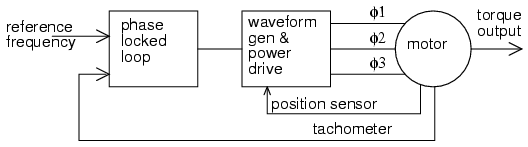
The block diagram (Figure above) shows the drive electronics associated with a low voltage (12 VDC) synchronous motor. These motors have a position sensor integrated within the motor, which provides a low level signal with a frequency proportional to the speed of rotation of the motor. The position sensor could be as simple as as solid state magnetic field sensors such as Hall effect devices providing commutation (armature current direction) timing to the drive electronics The position sensor could be a high resolution angular sensor such as a resolver,
an inductosyn (magnetic encoder), or an optical encoder.
If constant and accurate speed of rotation is required, (as for a disk drive) a tachometer and phase locked loop may be included. (Figure below) This tachometer signal, a pulse train proportional to motor speed, is fed back to a phase locked loop, which compares the tachometer frequency and phase to a stable reference frequency source such as a crystal oscillator.


Phase locked loop controls synchronous motor speed.
A motor driven by square waves of current, as provided by simple hall effect sensors, is known as abrushless DC motor. This type of motor has higher ripple torque torque variation through a shaft revolution than a sine wave driven motor. This is not a problem for many applications. Though, we are primarily interested in synchronous motors in this section.


Motor ripple torque and mechanical analog.
Ripple torque, or cogging is caused by magnetic attraction of the rotor poles to the stator pole pieces. (Figure above) Note that there are no stator coils, not even a motor. The PM rotor may be rotated by hand but will encounter attraction to the pole pieces when near them. This is analogous to the mechanical situation. Would ripple torque be a problem for a motor used in a tape player? Yes, we do not want the motor to alternately speed and slow as it moves audio tape past a tape playback head. Would ripple torque be a problem for a fan motor? No.

Windings distributed in a belt produce a more sinusoidal field.
If a motor is driven by sinewaves of current synchronous with the motor back emf, it is classified as a synchronous AC motor, regardless of whether the drive waveforms are generated by electronic means. A synchronous motor will generate a sinusoidal back emf if the stator magnetic field has a sinusoidal distribution. It will be more sinusoidal if pole windings are distributed in a belt (Figure above) across many slots instead of concentrated on one large pole (as drawn in most of our simplified illustrations). This arrangement cancels many of the stator field odd harmonics. Slots having fewer windings at the edge of the phase winding may share the space with other phases.

Winding belts may take on an alternate concentric form as shown in Figure below.


Concentric belts.
For a 2-phase motor, driven by a sinewave, the torque is constant throughout a revolution by the trigonometric identity:
 sin2θ + cos2θ = 1 
The generation and synchronization of the drive waveform requires a more precise rotor position indication than provided by the hall effect sensors used in brushless DC motors. A resolver, or optical or magnetic encoder provides resolution of hundreds to thousands of parts (pulses) per revolution. A resolver provides analog angular position signals in the form of signals proportional to the sine and cosine of shaft angle. Encoders provide a digital angular position indication in either serial or parallel format. The sine wave drive may actually be from a PWM, Pulse Width Modulator, a high efficiency method of approximating a sinewave with a digital waveform. (Figure below) Each phase requires drive electronics for this wave form phase-shifted by the appropriate amount per phase.


PWM approximates a sinewave.
Synchronous motor efficiency is higher than that of induction motors. The synchronous motor can also be smaller, especially if high energy permanent magnets are used in the rotor. The advent of modern solid state electronics makes it possible to drive these motors at variable speed. Induction motors are mostly used in railway traction. However, a small synchronous motor, which mounts inside a drive wheel, makes it attractive for such applications. The high temperature superconducting version of this motor is one fifth to one third the weight of a copper wound motor. The largest experimental superconducting synchronous motor is capable of driving a naval destroyer class ship. In all these applications the electronic variable speed drive is essential.
The variable speed drive must also reduce the drive voltage at low speed due to decreased inductive reactance at lower frequency. To develop maximum torque, the rotor needs to lag the stator field direction by 90o. Any more, it loses synchronization. Much less results in reduced torque. Thus, the position of the rotor needs to be known accurately. And the position of the rotor with respect to the stator field needs to be calculated, and controlled. This type of control is known as vector phase control. It is implemented with a fast microprocessor driving a pulse width modulator for the stator phases.
The stator of a synchronous motor is the same as that of the more popular induction motor. As a result the industrial grade electronic speed control used with induction motors is also applicable to large industrial synchronous motors.
If the rotor and stator of a conventional rotary synchronous motor are unrolled, a synchronous linear motor results. This type of motor is applied to precise high speed linear positioning.
A larger version of the linear synchronous motor with a movable carriage containing high energy NdBFe permanent magnets is being developed to launch aircraft from naval aricraft carriers.

Working Principle Of A DC Motor

A motor is an electrical machine which converts electrical energy into mechanical energy. The principle of working of a DC motor is that "whenever a current carrying conductor is placed in a magnetic field, it experiences a mechanical force". The direction of this force is given by Fleming's left hand rule and it's magnitude is given by F = BIL. Where, B = magnetic flux density, I = current and L = length of the conductor within the magnetic field.

Fleming's left hand rule: If we stretch the first finger, second finger and thumb of our left hand to be perpendicular to each other AND direction of magnetic field is represented by the first finger, direction of the current is represented by second finger then the thumb represents the direction of the force experienced by the current carrying conductor.

Working of dc motor animation
working of dc motor animation
Above animation helps in understanding the working principle of a DC motor. When armature windings are connected to a DC supply, current sets up in the winding. Magnetic field may be provided by field winding (electromagnetism) or by using permanent magnets. In this case, current carrying armature conductors experience force due to the magnetic field, according to the principle stated above.

Commutator is made segmented to achieve unidirectional torque. Otherwise, the direction of force would have reversed every time when the direction of movement of conductor is reversed the magnetic field.
This is how a DC motor works!

Back EMF
According to fundamental laws of nature, no energy conversion is possible until there is something to oppose the conversion. In case of generators this opposition is provided by magnetic drag, but in case of dc motors there is back emf.

When the armature of the motor is rotating, the conductors are also cutting the magnetic flux lines  and hence according to the Faraday's law of electromagnetic induction, an emf induces in the armature conductors. The direction of this induced emf is such that it opposes the armature current (Ia) . The circuit diagram below illustrates the direction of the back emf and armature current. Magnitude of Back emf can be given by the emf equation of DC generator.


Significance Of Back Emf:

Magnitude of back emf is directly proportional to speed of the motor. Consider the load on a dc motor is suddenly reduced. In this case, required torque will be small as compared to the current torque. Speed of the motor will start increasing due to the excess torque. Hence, being proportional to the speed, magnitude of the back emf will also increase. With increasing back emf armature current will start decreasing. Torque being proportional to the armature current, it will also decrease until it becomes sufficient for the load. Thus, speed of the motor will regulate. 
On the other hand, if a dc motor is suddenly loaded, the load will cause decrease in the speed. Due to decrease in speed, back emf will also decrease allowing more armature current. Increased armature current will increase the torque to satisfy the load requirement. Hence, presence of the back emf makes a dc motor ‘self-regulating’.
Types Of DC Motors 
DC motors are usually classified of the basis of their excitation configuration, as follows -
Separately excited (field winding is fed by external source)
Self excited -
Series wound (field winding is connected in series with the armature)
Shunt wound (field winding is connected in parallel with the armature)
Compound wound - 
Long shunt
Short shunt

Electric generator

Principle of DC Generator

There are two types of generators, one is ac generator and other is dc generator. Whatever may be the types of generators, it always converts mechanical power to electrical power. An ac generator produces alternating power. A DC generator produces direct power. Both of these generators produce electrical power, based on same fundamental principle of Faraday's law of electromagnetic induction. According to these law, when an conductor moves in a magnetic field it cuts magnetic lines force, due to which an emf is induced in the conductor. The magnitude of this induced emf depends upon the rate of change of flux (magnetic line force) linkage with the conductor. This emf will cause an current to flow if the conductor circuit is closed.

Hence the most basic tow essential parts of a generator are a) a magnetic field and b) conductors which move inside that magnetic field Now we will go through working principle of dc generator. As, the working principle of ac generator is not in scope of our discussion in this section.

Single Loop DC Generator

single loop dc generator In the figure above, a single loop of conductor of rectangular shape is placed between two opposite poles of magnet.
Let's us consider, the rectangular loop of conductor is ABCD which rotates inside the about its own axis ab. When the loop rotates from its vertical position to its horizontal position, it cuts the flux lines of the field. As during this movement two sides, i.e. AB and CD of the loop cut the flux lines there will be an emf induced in these both of the sides (AB & BC) of the loop.
Single Loop generator
As the loop is closed there will be a current circulating through the loop. The direction of the current can be determined by Flemming's right hand Rule. This rule says that is you stretch thumb, index finger and middle finger of your right hand perpendicular to each other, then thumbs indicates the direction of motion of the conductor, index finger indicates the direction of magnetic field i.e. N - pole to S - pole, and middle finger indicates the direction of flow of current through the conductor.

Now if we apply this right hand rule, we will see at this horizontal position of the loop, current will flow from point A to B and on the other side of the loop current will flow from point C to D. single-loop-dc-generator-2 Now if we allow the loop to move further, it will come again to its vertical position, but now upper side of the loop will be CD and lower side will be AB (just opposite of the previous vertical position). At this position the tangential motion of the sides of the loop is parallel to the flux lines of the field. Hence there will be no question of flux cutting and consequently there will be no current in the loop. If the loop rotates further, it comes to again in horizontal position. But now, said AB side of the loop comes in front of N pole and CD comes in front of S pole, i.e. just opposite to the previous horizontal position as shown in the figure beside. single-loop-dc-generator-3
Here the tangential motion of the side of the loop is perpendicular to the flux lines, hence rate of flux cutting is maximum here and according to Flemming's right hand rule, at this position current flows from B to A and on other side from D to C.

Now if the loop is continued to rotate about its axis, every time the side AB comes in front of S pole, the current flows from A to B and when it comes in front of N pole, the current flows from B to A. Similarly, every time the side CD comes in front of S pole the current flows from C to D and when it comes in front of N pole the current flows from D to C.
If we observe this phenomena in different way, it can be concluded, that each side of the loop comes in front of N pole, the current will flow through that side in same direction i.e. downward to the reference plane and similarly each side of the loop comes in front of S pole, current through it flows in same direction i.e. upwards from reference plane. From this, we will come to the topic of principle of dc generator. Now the loop is opened and connect it with a split ring as shown in the figure below. Split ring are made out of a conducting cylinder which cuts into two halves or segments insulated from each other. The external load terminals are connected with two carbon brushes which are rest on these split slip ring segments.

Working Principle of DC Generator

dc generator loop It is seen that in the first half of the revolution current flows always along ABLMCD i.e. brush no 1 in contact with segment a. In the next half revolution, in the figure the direction of the induced current in the coil is reversed. But at the same time the position of the segments a and b are also reversed which results that brush no 1 comes in touch with that segment b. Hence, the current in the load resistence again flows from L to M. The wave from of the current through the load circuit is as shown in the figure. This current is unidirectional.
dc wave
This is basic working principle of DC generator, explained by single loop generator model.
The position of the brushes of DC generator is so arranged that the change over of the segments a and b from one brush to other takes place when the plane of rotating coil is at right angle to the plane of the lines of force. It is so become in that position, the induced emf in the coil is zero.

Voltage Transformer Basics


One of the main reasons that we use alternating AC voltages and currents in our homes and workplace’s is that AC supplies can be easily generated at a convenient voltage, transformed (hence the name transformer) into much higher voltages and then distributed around the country using a national grid of pylons and cables over very long distances.
The reason for transforming the voltage to a much higher level is that higher distribution voltages implies lower currents for the same power and therefore lower I2R losses along the networked grid of cables. These higher AC transmission voltages and currents can then be reduced to a much lower, safer and usable voltage level where it can be used to supply electrical equipment in our homes and workplaces, and all this is possible thanks to the basic Voltage Transformer.
voltage transformer basics
A Typical Voltage Transformer
The Voltage Transformer can be thought of as an electrical component rather than an electronic component. A transformer basically is very simple static (or stationary) electro-magnetic passive electrical device that works on the principle of Faraday’s law of induction by converting electrical energy from one value to another.
The transformer does this by linking together two or more electrical circuits using a common oscillating magnetic circuit which is produced by the transformer itself. A transformer operates on the principals of “electromagnetic induction”, in the form of  Mutual Induction.
Mutual induction is the process by which a coil of wire magnetically induces a voltage into another coil located in close proximity to it. Then we can say that transformers work in the “magnetic domain”, and transformers get their name from the fact that they “transform” one voltage or current level into another.
Transformers are capable of either increasing or decreasing the voltage and current levels of their supply, without modifying its frequency, or the amount of Electrical Power being transferred from one winding to another via the magnetic circuit.
A single phase voltage transformer basically consists of two electrical coils of wire, one called the “Primary Winding” and another called the “Secondary Winding”. For this tutorial we will define the “primary” side of the transformer as the side that usually takes power, and the “secondary” as the side that usually delivers power. In a single-phase voltage transformer the primary is usually the side with the higher voltage.
These two coils are not in electrical contact with each other but are instead wrapped together around a common closed magnetic iron circuit called the “core”. This soft iron core is not solid but made up of individual laminations connected together to help reduce the core’s losses.
The two coil windings are electrically isolated from each other but are magnetically linked through the common core allowing electrical power to be transferred from one coil to the other. When an electric current passed through the primary winding, a magnetic field is developed which induces a voltage into the secondary winding as shown.

Single Phase Voltage Transformer

single phase voltage transformer
In other words, for a transformer there is no direct electrical connection between the two coil windings, thereby giving it the name also of an Isolation Transformer. Generally, the primary winding of a transformer is connected to the input voltage supply and converts or transforms the electrical power into a magnetic field. While the job of the secondary winding is to convert this alternating magnetic field into electrical power producing the required output voltage as shown.

Transformer Construction (single-phase)

transformer basic construction
  • Where:
  •   VP  -  is the Primary Voltage
  •   VS  -  is the Secondary Voltage
  •   NP  -  is the Number of Primary Windings
  •   NS  -  is the Number of Secondary Windings
  •   Φ (phi)  -  is the Flux Linkage
Notice that the two coil windings are not electrically connected but are only linked magnetically. A single-phase transformer can operate to either increase or decrease the voltage applied to the primary winding. When a transformer is used to “increase” the voltage on its secondary winding with respect to the primary, it is called a Step-up transformer. When it is used to “decrease” the voltage on the secondary winding with respect to the primary it is called a Step-down transformer.
However, a third condition exists in which a transformer produces the same voltage on its secondary as is applied to its primary winding. In other words, its output is identical with respect to voltage, current and power transferred. This type of transformer is called an “Impedance Transformer” and is mainly used for impedance matching or the isolation of adjoining electrical circuits.
The difference in voltage between the primary and the secondary windings is achieved by changing the number of coil turns in the primary winding ( NP ) compared to the number of coil turns on the secondary winding ( NS ).
As the transformer is basically a linear device, a ratio now exists between the number of turns of the primary coil divided by the number of turns of the secondary coil. This ratio, called the ratio of transformation, more commonly known as a transformers “turns ratio”, ( TR ). This turns ratio value dictates the operation of the transformer and the corresponding voltage available on the secondary winding.
It is necessary to know the ratio of the number of turns of wire on the primary winding compared to the secondary winding. The turns ratio, which has no units, compares the two windings in order and is written with a colon, such as 3:1 (3-to-1). This means in this example, that if there are 3 volts on the primary winding there will be 1 volt on the secondary winding, 3 volts-to-1 volt. Then we can see that if the ratio between the number of turns changes the resulting voltages must also change by the same ratio, and this is true.
Transformers are all about “ratios”. The ratio of the primary to the secondary, the ratio of the input to the output, and the turns ratio of any given transformer will be the same as its voltage ratio. In other words for a transformer: “turns ratio = voltage ratio”. The actual number of turns of wire on any winding is generally not important, just the turns ratio and this relationship is given as:

A Transformers Turns Ratio

transformer turns ratio equation
Assuming an ideal transformer and the phase angles:  ΦP ≡ ΦS
Note that the order of the numbers when expressing a transformers turns ratio value is very important as the turns ratio 3:1 expresses a very different transformer relationship and output voltage than one in which the turns ratio is given as: 1:3.

Transformer Basics Example No1

A voltage transformer has 1500 turns of wire on its primary coil and 500 turns of wire for its secondary coil. What will be the turns ratio (TR) of the transformer.
transformer turns ratio
This ratio of 3:1 (3-to-1) simply means that there are three primary windings for every one secondary winding. As the ratio moves from a larger number on the left to a smaller number on the right, the primary voltage is therefore stepped down in value as shown.

Transformer Basics Example No2

If 240 volts rms is applied to the primary winding of the same transformer above, what will be the resulting secondary no load voltage.
secondary voltage transformer basics
Again confirming that the transformer is a “step-down transformer as the primary voltage is 240 volts and the corresponding secondary voltage is lower at 80 volts.
Then the main purpose of a transformer is to transform voltages at preset ratios and we can see that the primary winding has a set amount or number of windings (coils of wire) on it to suit the input voltage. If the secondary output voltage is to be the same value as the input voltage on the primary winding, then the same number of coil turns must be wound onto the secondary core as there are on the primary core giving an even turns ratio of 1:1 (1-to-1). In other words, one coil turn on the secondary to one coil turn on the primary.
If the output secondary voltage is to be greater or higher than the input voltage, (step-up transformer) then there must be more turns on the secondary giving a turns ratio of 1:N (1-to-N), where N represents the turns ratio number. Likewise, if it is required that the secondary voltage is to be lower or less than the primary, (step-down transformer) then the number of secondary windings must be less giving a turns ratio of N:1 (N-to-1).

Transformer Action

We have seen that the number of coil turns on the secondary winding compared to the primary winding, the turns ratio, affects the amount of voltage available from the secondary coil. But if the two windings are electrically isolated from each other, how is this secondary voltage produced?
We have said previously that a transformer basically consists of two coils wound around a common soft iron core. When an alternating voltage ( VP ) is applied to the primary coil, current flows through the coil which in turn sets up a magnetic field around itself, called mutual inductance, by this current flow according to Faraday’s Law of electromagnetic induction. The strength of the magnetic field builds up as the current flow rises from zero to its maximum value which is given asdΦ/dt.
transformer basics of flux linkage
As the magnetic lines of force setup by this electromagnet expand outward from the coil the soft iron core forms a path for and concentrates the magnetic flux. This magnetic flux links the turns of both windings as it increases and decreases in opposite directions under the influence of the AC supply.
However, the strength of the magnetic field induced into the soft iron core depends upon the amount of current and the number of turns in the winding. When current is reduced, the magnetic field strength reduces.
When the magnetic lines of flux flow around the core, they pass through the turns of the secondary winding, causing a voltage to be induced into the secondary coil. The amount of voltage induced will be determined by: N.dΦ/dt (Faraday’s Law), where N is the number of coil turns. Also this induced voltage has the same frequency as the primary winding voltage.
Then we can see that the same voltage is induced in each coil turn of both windings because the same magnetic flux links the turns of both the windings together. As a result, the total induced voltage in each winding is directly proportional to the number of turns in that winding. However, the peak amplitude of the output voltage available on the secondary winding will be reduced if the magnetic losses of the core are high.
If we want the primary coil to produce a stronger magnetic field to overcome the cores magnetic losses, we can either send a larger current through the coil, or keep the same current flowing, and instead increase the number of coil turns ( NP ) of the winding. The product of amperes times turns is called the “ampere-turns”, which determines the magnetising force of the coil.
So assuming we have a transformer with a single turn in the primary, and only one turn in the secondary. If one volt is applied to the one turn of the primary coil, assuming no losses, enough current must flow and enough magnetic flux generated to induce one volt in the single turn of the secondary. That is, each winding supports the same number of volts per turn.
As the magnetic flux varies sinusoidally, Φ = Φmax sinωt, then the basic relationship between induced emf, ( E ) in a coil winding of N turns is given by:

emf = turns x rate of change

transformer emf equation
  • Where:
  •   ƒ  -  is the flux frequency in Hertz,  = ω/2π
  •   Ν  -  is the number of coil windings.
  •   Φ  -  is the flux density in webers
This is known as the Transformer EMF Equation. For the primary winding emf, N will be the number of primary turns, ( NP ) and for the secondary winding emf, N will be the number of secondary turns, ( NS ).
Also please note that as transformers require an alternating magnetic flux to operate correctly, transformers cannot therefore be used to transform or supply DC voltages or currents, since the magnetic field must be changing to induce a voltage in the secondary winding. In other words,transformers DO NOT operate on steady state DC voltages, only alternating or pulsating voltages.
If a transformers primary winding was connected to a DC supply, the inductive reactance of the winding would be zero as DC has no frequency, so the effective impedance of the winding will therefore be very low and equal only to the resistance of the copper used. Thus the winding will draw a very high current from the DC supply causing it to overheat and eventually burn out, because as we know I = V/R.

Transformer Basics Example No3

A single phase transformer has 480 turns on the primary winding and 90 turns on the secondary winding. The maximum value of the magnetic flux density is 1.1T when 2200 volts, 50Hz is applied to the transformer primary winding. Calculate:
a). The maximum flux in the core.
transformer core magnetic flux
b). The cross-sectional area of the core.
transformer core cross sectional area
c). The secondary induced emf.
transformer secondary emf

Electrical Power in a Transformer

Another one of the transformer basics parameters is its power rating. Transformers are rated inVolt-amperes, ( VA ), or in larger units of Kilo Volt-amperes, ( kVA ). In an ideal transformer (ignoring any losses), the power available in the secondary winding will be the same as the power in the primary winding, they are constant wattage devices and do not change the power only the voltage to current ratio. Thus, in an ideal transformer the Power Ratio is equal to one (unity) as the voltage, V multiplied by the current, I will remain constant.
That is the electric power at one voltage/current level on the primary is “transformed” into electric power, at the same frequency, to the same voltage/current level on the secondary side. Although the transformer can step-up (or step-down) voltage, it cannot step-up power. Thus, when a transformer steps-up a voltage, it steps-down the current and vice-versa, so that the output power is always at the same value as the input power. Then we can say that primary power equals secondary power, ( PP = PS ).

Power in a Transformer

transformer basics power
Where: ΦP is the primary phase angle and ΦS is the secondary phase angle.
Note that since power loss is proportional to the square of the current being transmitted, that is:I2R, increasing the voltage, let’s say doubling ( ×2 ) the voltage would decrease the current by the same amount, ( ÷2 ) while delivering the same amount of power to the load and therefore reducing losses by factor of 4. If the voltage was increased by a factor of 10, the current would decrease by the same factor reducing overall losses by factor of 100.

Transformer Basics – Efficiency

A transformer does not require any moving parts to transfer energy. This means that there are no friction or windage losses associated with other electrical machines. However, transformers do suffer from other types of losses called “copper losses” and “iron losses” but generally these are quite small.
Iron losses, also known as hysteresis is the lagging of the magnetic molecules within the core, in response to the alternating magnetic flux. This lagging (or out-of-phase) condition is due to the fact that it requires power to reverse magnetic molecules; they do not reverse until the flux has attained sufficient force to reverse them.Copper losses, also known as I2R loss is the electrical power which is lost in heat as a result of circulating the currents around the transformers copper windings, hence the name. Copper losses represents the greatest loss in the operation of a transformer. The actual watts of power lost can be determined (in each winding) by squaring the amperes and multiplying by the resistance in ohms of the winding (I2R).
Their reversal results in friction, and friction produces heat in the core which is a form of power loss. Hysteresis within the transformer can be reduced by making the core from special steel alloys.
The intensity of power loss in a transformer determines its efficiency. The efficiency of a transformer is reflected in power (wattage) loss between the primary (input) and secondary (output) windings. Then the resulting efficiency of a transformer is equal to the ratio of the power output of the secondary winding, PS to the power input of the primary winding, PP and is therefore high.
An ideal transformer is 100% efficient because it delivers all the energy it receives. Real transformers on the other hand are not 100% efficient and at full load, the efficiency of a transformer is between 94% to 96% which is quiet good. For a transformer operating with a constant voltage and frequency with a very high capacity, the efficiency may be as high as 98%. The efficiency, η of a transformer is given as:

Transformer Efficiency

transformer efficiency
where: Input, Output and Losses are all expressed in units of power.
Generally when dealing with transformers, the primary watts are called “volt-amps”, VA to differentiate them from the secondary watts. Then the efficiency equation above can be modified to:
transformer basics - efficiency
It is sometimes easier to remember the relationship between the transformers input, output and efficiency by using pictures. Here the three quantities of VAW and η have been superimposed into a triangle giving power in watts at the top with volt-amps and efficiency at the bottom. This arrangement represents the actual position of each quantity in the efficiency formulas.